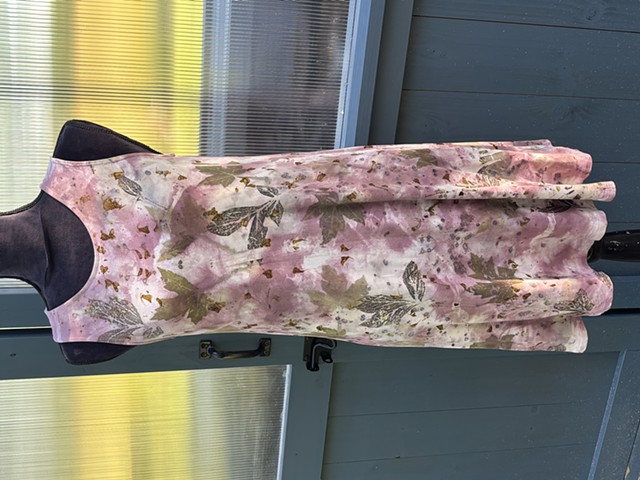
ECO PRINT OVERVIEW
ECO PRINTING - HOW TO DO IT
How the Process Works (Step-by-Step)
The method relies on a tight contact print. Here is how a typical botanical print is made:
1. Scouring (Cleaning): The fabric must be washed with a gentle, pH-neutral soap or soda ash. This removes any commercial oils, waxes, or finishes that would block the plant dyes from absorbing.
2. Mordanting (Fixing the Color): Natural dyes need a "bridge" to help them stick to fabric permanently. The fabric is soaked in a mordant—usually a natural mineral solution like alum (potassium aluminum sulfate) or iron water (made by soaking rusty nails in water and vinegar).
3. Arranging the Botanicals: Fresh or dried leaves and petals are laid flat across the damp fabric. The backs of the leaves are usually placed face-down because they contain the highest concentration of sap and tannins.
4. Tightly Bundling: The fabric is rolled tightly around a dowel or metal pipe (like copper or iron) to create a firm cylinder. It is wrapped tightly with string. Extreme pressure is mandatory; if the bundle is loose, the prints will bleed and blur instead of coming out crisp.
5. Cooking (Steaming or Boiling): The bundle is placed into a large pot to be steamed or submerged in simmering water for 1.5 to 3 hours. The heat breaks down the plant cells and pushes the dye into the mordanted fabric.
6. The Reveal: Once cooled, the bundle is untied, and the organic plant matter is scraped away to reveal exact, permanent botanical prints.Crucial Factors for Success
• The Right Fabric: Protein-based animal fibers (silk, wool, cashmere) take botanical dyes beautifully and are easiest for beginners. Cellulose plant fibers (cotton, linen, hemp) require much more intensive scouring and mordanting to absorb the colors well.
• High-Tannin Plants: Not every plant leaves a mark. The best results come from species packed with natural tannins or Substantive dyes. Excellent beginner plants include eucalyptus, maple leaves, oak leaves, smoke bush, rose leaves, and dark onion skins.
• Metal Interaction: Using copper or rusty iron pipes to roll the fabric creates chemical reactions. Iron "saddens" or darkens the colors, shifting bright greens and yellows into deep charcoals, grays, and rich blacks.A mordant is a natural mineral or chemical compound that acts as a bridge between fabric fibers and plant dyes. Because most natural dyes cannot bind to fabric on their own, a mordant chemically locks the color into the material so it will not wash out in the laundry or fade in the sun.
🧪 Why Mordants are Essential
• Fixes Color: Creates a permanent chemical bond.
• Prevents Fading: Increases light-fastness and wash-fastness.
• Alters Hues: Shifts colors depending on the metal used.🪵 The Most Common Mordants
Mordant Name Chemical / Source
Alum Potassium aluminum sulfate
Brightens and clears original colors
Safest option for beginners, excellent for silk and woolIron (Ferrous) Ferrous sulfate / Rusty nails
"Saddens" colors, turning yellows into deep olives and grays
Creating stark, dark outlines in eco-printingCopper Copper sulfate / Copper pipes
Enhances greens and yields warm gold tones
Shifting muted yellows into vibrant chartreuseTannins Oak galls, sumac, black tea
Deepens colors and acts as a pre-mordant base
Preparing plant-based fabrics (cotton/linen)
To get you started, here is how to choose and make your mordant based on your fabric:
🧺 Step 1: Choose by Fabric Type
• For Silk or Wool: Use Alum (you can buy this in the spice aisle at the grocery store). It is safe, easy, and keeps colors bright.
• For Cotton or Linen: You need a Tannin + Alum combo. Soak the fabric in strong black tea (tannin) first, then soak it in an alum bath.🪵 Alternative: How to Make a Free "Iron" Mordant at Home
If you want dark, moody prints with deep grays and rich blacks, you can make an iron solution for free:
1. Put a handful of rusty nails or screws into a glass jar.
2. Fill the jar with 1 part white vinegar and 2 parts water.
3. Close the lid and let it sit for 1 to 2 weeks until the liquid turns orange-brown.
4. Strain out the liquid. Dilute a splash of this iron water into a bucket of plain water to create your dipping bath.
BIO
JULIE FRIEDMAN'S BIO
Artists all have memories of childhood drawings and stories about pictures they made. I took art classes as a child and still have pastel drawings I did as an 8 or 9 year old. I had encouraging relatives and remember getting positive feedback from a revered cousin who claimed one of my drawings for her office wall.
I took commercial art classes in high school and went off to Kent State University sure that art was my thing. It wasn’t! The artwork I did in my classes was mediocre at best. I stayed with it for about a year and a half and then decided to major in Interior Design. I really liked the classes I took as they encompassed architecture, textiles, design and color.
After I received my Bachelor of Arts degree in 1980 I had some jobs that were tangentially Interior Design related. I did drafting (before computers); I sold furniture and decorative hardware and bathroom fixtures. I worked retail and I traveled to Europe a few times. Once I went on an archeological dig in England, once to London to intern in a museum. And just to travel. I felt that Interior Design was not a good fit for me- I am too quiet, I am not a sales person and you have to constantly sell yourself. Each time I came back to Cleveland from my travels I was in a quandary about what to do with my life…I had many ideas, textile design, window displays, museum studies, historic preservation, move to New York or Boston or London.
But finally I decided to return to college and work on getting an art education degree and becoming a teacher. I went back to Kent to take another try at art classes to work on getting together a strong portfolio for the program I wanted to enter. Well this time around, older, wiser and more intent on success, I loved art classes and did very well. After a couple classes in painting and drawing I decided to complete an art degree before choosing a career. I spent 3 years taking painting, drawing and printmaking and feeling good about being in school. I got a Bachelor of Fine Arts, majoring in printmaking.
I had to make a huge decision at that point- Go for the Art Education program or for a totally impractical Master of Fine Arts degree. I chose the unsafe, unpredictable, expensive, Fine Arts Degree. After a few false starts in finding the right school I went off to the University of Wisconsin- Madison where I spent 2 very happy (and cold) years. I made some good friends. Madison is where I discovered artist books and Walter Hamady and a whole new world opened up to me. Read more about my feelings for books in my statement under the artist book gallery page(in Older Work).
I graduated in 1991 with an MFA, got married and live on 10 acres of land in Medina, Ohio with my artist husband, Charles Basham, and an ever changing number of dogs and cats. We each have a studio here on the farm and I have an additional space on the historic Medina Public Square.
Since about 1996 I have been an adjunct professor teaching drawing, printmaking, painting and design at a variety of colleges and universities in Northeast Ohio. I drive a lot! Some semesters I drive 400 miles weekly to my teaching jobs. I enjoy teaching in a way that I never enjoyed making a living before. I am also the co- director of Gallery West at Cuyahoga Community College in Cleveland, Ohio.
I try to spend a couple days a week in my studio so that teaching doesn’t become my life instead of art. Some semesters it is harder than others. In the summer I am sometimes able to find a teaching job but more often I get a chance to spend more time in the studio (but not making much money) and the garden. It is a trade off. But this lifestyle is the right fit- finally.
This May 2016 I will head up to Glen Arbor, Michigan for a 2 week residency
Material Concepts website. This is where I buy my Tyvek- Read the Blog about me
Around Kent Magazine features my artwork - Volume 4 2014
Page 38-39
issuu.com/aroundkent/docs/aroundkent_ma…William Busta writes about A Greenhouse for Life
95th Toledo Area Artists Exhibition
November 21 2014 - January 4 2015
I am one of 28 artists invited to participate in this exhibition.
www.toledomuseum.org/exhibitions/95th-a…Akron Artprize
This citywide competition will open on September 6 and run through October 4, 2014.
My artwork 'Winds of Change" will be displayed at the Summit Artspace Gallery
140 East Market Street, Akron, OH 44308
phone: 330-376-8480
fax: 330-379-9475
Email: don@akronareaarts.org
Summit Artspace
Please vote for my entry!Grand Rapids, MI Artprize 2014
Artprize in Grand Rapids, MI is September 24- October12. I have a piece called A Greenhouse For Life that will be displayed at Cathedral Square. I am very excited. Please go to Grand Rapids and vote for me!
To See My Entry Click HereSky High at the Riffe Gallery in Columbus
I am proud to be included in this exhibit. I will show 3 works. The exhibit dates are July 31- October 19, 2014. There is an opening reception on July 31 from 5-7 pm
Ohio Arts Council- Riffe GalleryWinter 2014
I am working on a new project for Artprize 2014 which will be held in September in Grand Rapids, MI. I have cut out yards and yards of Tyvek which will be constructed to create a 3 dimensional greenhouse. The dimensions will be 8-10 feet tall, 12 feet long and 4 feet wide. You will be able to walk through the finished house. I will post pictures when complete.
I have also completed a 3 dimensional column of cut Tyvek that hangs from the ceiling and is 8 feet tall and will slowly turn from a small motor. It is called Vortex and will be exhibited at the Kent State Faculty show starting January 14 and then again at the Riffe Gallery in Columbus in July.
Perennial Shift
William Busta Gallery
2731 Prospect Ave
Cleveland, Ohio 44115
216-298-9071www.williambustagallery.com
bustagallery@gmail.comJanuary 4- February 9 2013
This was a solo show with 10 new artworks- all cut paper. Also exhibited Eutopia. This is the installation I created for Artprize last summer. It is 12 feet wide and about 8 feet tall.Artprize 2012
Artprize.org is a very cool citywide competition in Grand Rapids Michigan starting on September 19 2012. I have just installed a very large piece of work displayed at the Riverfront Plaza Building HighFive Venue. I need you to vote for my artwork and I could win a very big prize! The artwork shown on my home page is what I created for the competition.
1/10/13- I did not win the big prize though I did get enough votes to be in the top 100! This is out of over 1500 entries. I will try again this year...
Heights Art Gallery, Cleveland Heights, Ohio
I am in a group show from September 7- October 20, 2012 at Heights Arts.
http://www.heightsarts.org/events.php
PAPERWORKS
Curated by Andrea Joki, the show illuminates paper as a carrier of artists’ symbols and as a medium in itself with processes including drawing, painting, cut paper, collage, sculpture and pulp.
The show coincides in its closing days with the International Association of Hand Papermakers (IAPMA) and Friends of Dard Hunter conference hosted by Cleveland’s Morgan Art of Papermaking Conservatory and Education Foundation.
Shelly DiCello, Tom Balbo, Tim Callaghan, Laura Cooperman, Julie Friedman, Sarah Kabot, Margaret Kimura, Michael Loderstedt, Liz Maugans, Pam McKee, Darice Polo, Corrie Slawson, Dan Tranberg, Achala Wali and Trudy Wiesenberger
Starting March 2, 2012 I will have a window display of artwork at the Downtown Gallery in Kent, Ohio
galleries.kent.edu/secondary/downtown/d…Article in COLUMBUS ALIVE magazine in November 2011
www.columbusalive.com/content/stories/2…
Julie Friedman is always on the lookout for lone trees. She lives outside of Medina and drives more than 400 miles each week to teach art classes at various schools in northeastern Ohio, so she has ample opportunity to enjoy the landscapes outside city limits.
Friedman photographs her subject, projects the image onto a giant roll of paper and then cuts out its silhouette. Trees, telephone poles and roots are the subjects of her exhibition, “Convergence,” at the Cultural Arts Center.
The title hints that these subjects are related: Roots resemble inverted trees, and telephone poles supplant trees as civilization radiates outward into the countryside. Though many people consider poles and wires ugly, Friedman said she finds the way wires cross and coil appealing.
“It becomes beautiful, just because you want it to be,” she said.
Trees are easier for us to embrace. The image of a tree is ubiquitous in art and design, perhaps because there aren’t many trees around us thanks to urban development, Friedman said.
“People just feel comfortable or familiar with it, or it takes them to another place,” she said of trees.
The negative spaces created by the holes in Friedman’s works are just as important as the silhouettes. Scrolls of white paper on white walls become a forest when the gallery’s lights flick on. Delicate branches and leaves cast shadows that give the works dimension and depth.
Friedman started working with cut-outs of trees and poles years ago in artist books, some of which are also featured in “Convergence.” Stand-alone shapes of clustered roots are a newer direction for Friedman, the idea harvested from the soil of her garden and a desire to break free from paper’s rectangular format.
Though this exhibition features her paper cuttings, Friedman works with many other techniques and media, which she says is both freeing and more challenging than working in one medium.
“I want to get an idea and then explore it in different media. For me, it’s harder to find the idea than to figure out what to do with it once I find it. I don’t like to limit myself,” she said.